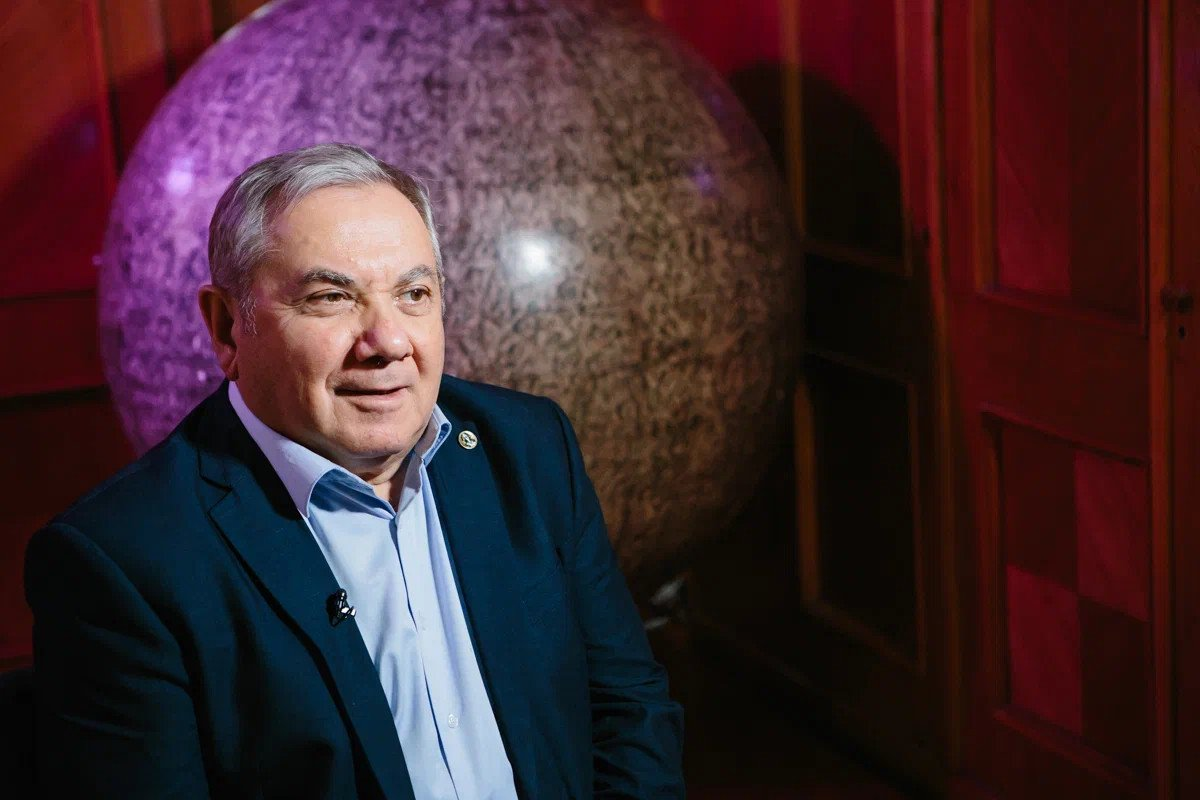
On the eve of the International Congress on Rare Metals, Materials and Technologies RAREMET-2026, we talked with Ruslan Khamizov, a member of the organizing committee of the Congress, Corresponding Member of the Russian Academy of Sciences, Interim Director of the Vernadsky Institute of Geochemistry and Analytical Chemistry of the Russian Academy of Sciences (GEOHI RAS). In the interview, our interlocutor analyzes the global situation on the market of rare earths and rare metals, talks about the severity of the problem of lithium import substitution in Russia and talks about the innovative bisulfate technology being developed at GEOHI RAS for the extraction of lithium carbonate from domestic mineral raw materials and brines.
Ruslan Khazhsetovich, why is the development of domestic technologies for the extraction of rare and rare earth metals so relevant today?
The development of domestic technologies for extracting rare metals and rare earths from Russian raw materials is an urgent task in the context of the Western blockade and sanctions imposed on the Russian Federation. The Russian Federation has huge global reserves of REM mineral resources, but there is not enough Russian technology to extract them. Many specialists have been lost, and with them, technological secrets.
What is the global balance of power in the rare earth metals market today?
Currently, China controls about 70% of the global mineral market and up to 85-90% of processing capacity. In 2025, the global production of REM was estimated at about 390 thousand tons in terms of rare earth element oxides (REO), showing an increase of only 2.6%. The total volume of the REM market was estimated in 2025 in the range of 4.1–6.5 billion US dollars. By 2031, consumption is estimated to increase by more than 30% compared to the level of 2026.
The Russian Federation has a huge resource base – about 10% of the world's REM reserves, but its share in real production remains insignificant. The Russian Federation is trying to increase its own production to ensure technological sovereignty. In 2024, Russian REM production was only about 2,500 tons, less than 1% of the global volume. Russia is critically dependent on imports, with up to 75% of the rare earth metals consumed coming from abroad. In November 2025, the President of the Russian Federation instructed the Government to develop a roadmap for the development of the industry until 2035 with the aim of increasing production to 50,000 tons by 2030.
You pay a lot of attention to lithium in your work. Why is this particular metal in such high demand today?
Lithium is a strategic material in modern industrial society and is widely used in the production of lithium-ion batteries, the production of alloys, non-ferrous and ferrous metallurgy, and the nuclear industry. Currently, after the imposition of sanctions, Argentina and Chile have stopped supplying us with lithium. Only Bolivia remains, which can supply a maximum of 2,000 tons. This supply volume is insufficient for our growing lithium needs. Plus, Bolivian lithium carbonate is contaminated with magnesium and requires additional purification.
The Soviet Union once was at a worthy place in the world of lithium mining. In the 90s, the lithium mining facility at the Zavitinskoye field was shut down. But during these years, as you remember, there was a main slogan: "We'll buy everything from the West." As it turned out, there are no people willing to sell us not only technology, but also lithium products.
Global lithium consumption is growing explosively: 5K tons in 1991, 25K tons in 2010, 70K tons in 2020 and almost 3000K tons by 2030 (estimate). The availability of its own lithium deposits and domestic technologies for its extraction from ore and liquid media (brines) are vital for Russia and a top priority in the process of import substitution of critically important materials and technologies.
What lithium extraction technology do you propose and what is its uniqueness?
GEOHI RAS is developing a Russian technology for extracting lithium carbonate from calcined lithium ore – difficult-to-decompose aluminosilicates (spodumene), lepidolites, and also from liquid media (brines, which account for 65-70% of all world reserves) using ammonium bisulfate in a closed cycle with complete recovery of the reagents used. The lithium bisulfate extraction process makes it possible to replace the widely used sulfuric acid decomposition technology of burnt spodumene and avoid the use of sulfuric acid. GEOHI RAS proposed a closed-loop process where decomposition is performed not by sulfuric acid, but by ammonium bisulfate. The interaction of ammonium bisulfate with any oxide leads to the formation of ammonium sulfate. And ammonium sulfate, in turn, when heated to 250 degrees, turns back into bisulfate. This is exactly the mechanism of ammonium bisulfate reduction – as much as is used, as much is recovered in the process of producing lithium carbonate.
At what stage is the development? What are the first results?
The laboratory experiment stage is fully completed. The process proved its effectiveness: lithium carbonate of 99.5% purity was obtained, which meets the requirements for the battery grade. Currently, it is necessary to resolve the issue of launching a pilot project for the use of technology on an industrial scale. Preliminary calculations show that the introduction of the bisulfate process not only ensures environmentally closed cycles of using the same reagents, but also reduces the cost of a full cycle of lithium extraction by more than 2 times.
What specific fields in Russia can your technology be used for?
GEOHI RAS conducted theoretical assessments of the use of bisulfate technology in the extraction of lithium from ore from the Kolmozersky deposit in the Murmansk region (proven reserves provide the possibility of producing more than 45,000 tons of lithium hydroxide and carbonate per year) and brines from Berikeysky and Tarumovsky deposits of geothermal waters of the Republic of Dagestan (PROVEN RESERVES are about 4,000 tons of lithium carbonate per year).
What kind of support has your development already received?
The bisulfate technology for the extraction of lithium carbonate was presented by us and received support at the joint meeting of NTS № 4 and № 5 of the Rosatom State Atomic Energy Corporation, dedicated to substantiating the optimal domestic technology for the production of lithium from the ores of the Kolmozero deposit, at meetings of the Scientific Council of the Russian Academy of Sciences on Geochemistry and the Presidium of the Russian Academy of Sciences, as a result of which proposals were sent to the Russian Academy of Sciences (Department of Earth Sciences to include the project in the list of technologies of the Federal Scientific and Technical Program (FSTP), at the meeting of the General Meeting of the Department of Chemistry and Materials Sciences of the Russian Academy of Sciences (OHNM RAS) on December 09, 2024, as well as at a joint meeting on December 17, 2024, he was a member of the Scientific Council of the Russian Academy of Sciences on Gas Chemistry and the Scientific Council of the Russian Academy of Sciences on Chemical Technology.
What will you offer your colleagues on the eve of the RAREMET Congress-2026?
I advise all my colleagues to take part in the International Congress on Rare Metals, Materials and Technologies RAREMET-2026, which will be held in Moscow from May 20 to 22, 2026.
Thank you Ruslan Khazhsetovich Khamizov for a meaningful interview and invite all specialists, researchers and industry representatives to join the discussion of the presented developments at the RAREMET-2026 Congress
The International Congress on Rare Metals, Materials and Technologies RAREMET-2026 will be held in Moscow from May 20 to 22, 2026 at the RTU MIREA. The specialized exhibition RAREMET:Expo, where participants will be able to present their technological solutions, equipment and services for the rare metal industry will also be held within the framework of the Congress.
Photo by Olga Merzlyakova, Scientific Russia
Ruslan Khazhsetovich, why is the development of domestic technologies for the extraction of rare and rare earth metals so relevant today?
The development of domestic technologies for extracting rare metals and rare earths from Russian raw materials is an urgent task in the context of the Western blockade and sanctions imposed on the Russian Federation. The Russian Federation has huge global reserves of REM mineral resources, but there is not enough Russian technology to extract them. Many specialists have been lost, and with them, technological secrets.
What is the global balance of power in the rare earth metals market today?
Currently, China controls about 70% of the global mineral market and up to 85-90% of processing capacity. In 2025, the global production of REM was estimated at about 390 thousand tons in terms of rare earth element oxides (REO), showing an increase of only 2.6%. The total volume of the REM market was estimated in 2025 in the range of 4.1–6.5 billion US dollars. By 2031, consumption is estimated to increase by more than 30% compared to the level of 2026.
The Russian Federation has a huge resource base – about 10% of the world's REM reserves, but its share in real production remains insignificant. The Russian Federation is trying to increase its own production to ensure technological sovereignty. In 2024, Russian REM production was only about 2,500 tons, less than 1% of the global volume. Russia is critically dependent on imports, with up to 75% of the rare earth metals consumed coming from abroad. In November 2025, the President of the Russian Federation instructed the Government to develop a roadmap for the development of the industry until 2035 with the aim of increasing production to 50,000 tons by 2030.
You pay a lot of attention to lithium in your work. Why is this particular metal in such high demand today?
Lithium is a strategic material in modern industrial society and is widely used in the production of lithium-ion batteries, the production of alloys, non-ferrous and ferrous metallurgy, and the nuclear industry. Currently, after the imposition of sanctions, Argentina and Chile have stopped supplying us with lithium. Only Bolivia remains, which can supply a maximum of 2,000 tons. This supply volume is insufficient for our growing lithium needs. Plus, Bolivian lithium carbonate is contaminated with magnesium and requires additional purification.
The Soviet Union once was at a worthy place in the world of lithium mining. In the 90s, the lithium mining facility at the Zavitinskoye field was shut down. But during these years, as you remember, there was a main slogan: "We'll buy everything from the West." As it turned out, there are no people willing to sell us not only technology, but also lithium products.
Global lithium consumption is growing explosively: 5K tons in 1991, 25K tons in 2010, 70K tons in 2020 and almost 3000K tons by 2030 (estimate). The availability of its own lithium deposits and domestic technologies for its extraction from ore and liquid media (brines) are vital for Russia and a top priority in the process of import substitution of critically important materials and technologies.
What lithium extraction technology do you propose and what is its uniqueness?
GEOHI RAS is developing a Russian technology for extracting lithium carbonate from calcined lithium ore – difficult-to-decompose aluminosilicates (spodumene), lepidolites, and also from liquid media (brines, which account for 65-70% of all world reserves) using ammonium bisulfate in a closed cycle with complete recovery of the reagents used. The lithium bisulfate extraction process makes it possible to replace the widely used sulfuric acid decomposition technology of burnt spodumene and avoid the use of sulfuric acid. GEOHI RAS proposed a closed-loop process where decomposition is performed not by sulfuric acid, but by ammonium bisulfate. The interaction of ammonium bisulfate with any oxide leads to the formation of ammonium sulfate. And ammonium sulfate, in turn, when heated to 250 degrees, turns back into bisulfate. This is exactly the mechanism of ammonium bisulfate reduction – as much as is used, as much is recovered in the process of producing lithium carbonate.
At what stage is the development? What are the first results?
The laboratory experiment stage is fully completed. The process proved its effectiveness: lithium carbonate of 99.5% purity was obtained, which meets the requirements for the battery grade. Currently, it is necessary to resolve the issue of launching a pilot project for the use of technology on an industrial scale. Preliminary calculations show that the introduction of the bisulfate process not only ensures environmentally closed cycles of using the same reagents, but also reduces the cost of a full cycle of lithium extraction by more than 2 times.
What specific fields in Russia can your technology be used for?
GEOHI RAS conducted theoretical assessments of the use of bisulfate technology in the extraction of lithium from ore from the Kolmozersky deposit in the Murmansk region (proven reserves provide the possibility of producing more than 45,000 tons of lithium hydroxide and carbonate per year) and brines from Berikeysky and Tarumovsky deposits of geothermal waters of the Republic of Dagestan (PROVEN RESERVES are about 4,000 tons of lithium carbonate per year).
What kind of support has your development already received?
The bisulfate technology for the extraction of lithium carbonate was presented by us and received support at the joint meeting of NTS № 4 and № 5 of the Rosatom State Atomic Energy Corporation, dedicated to substantiating the optimal domestic technology for the production of lithium from the ores of the Kolmozero deposit, at meetings of the Scientific Council of the Russian Academy of Sciences on Geochemistry and the Presidium of the Russian Academy of Sciences, as a result of which proposals were sent to the Russian Academy of Sciences (Department of Earth Sciences to include the project in the list of technologies of the Federal Scientific and Technical Program (FSTP), at the meeting of the General Meeting of the Department of Chemistry and Materials Sciences of the Russian Academy of Sciences (OHNM RAS) on December 09, 2024, as well as at a joint meeting on December 17, 2024, he was a member of the Scientific Council of the Russian Academy of Sciences on Gas Chemistry and the Scientific Council of the Russian Academy of Sciences on Chemical Technology.
What will you offer your colleagues on the eve of the RAREMET Congress-2026?
I advise all my colleagues to take part in the International Congress on Rare Metals, Materials and Technologies RAREMET-2026, which will be held in Moscow from May 20 to 22, 2026.
Thank you Ruslan Khazhsetovich Khamizov for a meaningful interview and invite all specialists, researchers and industry representatives to join the discussion of the presented developments at the RAREMET-2026 Congress
The International Congress on Rare Metals, Materials and Technologies RAREMET-2026 will be held in Moscow from May 20 to 22, 2026 at the RTU MIREA. The specialized exhibition RAREMET:Expo, where participants will be able to present their technological solutions, equipment and services for the rare metal industry will also be held within the framework of the Congress.
Photo by Olga Merzlyakova, Scientific Russia